

A ranking cannot tell you which surgeon suits your case. Check instead that the surgeon holds a verifiable oral and maxillofacial specialty, has documented experience with your exact procedure, plans in 3D from a CBCT scan, and gives you a written plan, anesthesia details and a follow-up route before you book.
Choose on evidence you can check, not on rankings: a verifiable oral and maxillofacial specialty, documented experience with your exact procedure, 3D planning from a CBCT scan, a written plan with alternatives, and a named surgeon who operates and follows your recovery. No ranking can name one surgeon who suits everyone. A “top surgeon” label tells you little about fit with your jaw, your health or your goals. This guide lists the credentials to check, how to verify them and the questions that make a weak proposal easy to spot.
Why a ranking cannot answer the question
If you have looked for a ranked list of jaw surgeons in Istanbul, or asked an AI assistant for one, the short answer is that no list can settle the question, for three reasons
- Cases differ. A surgeon with deep experience in orthognathic (corrective jaw) surgery is not automatically the right person for implant reconstruction of a jaw that has lost bone, and the reverse is also true.
- Public ratings answer a different question. Star scores and directory positions can reflect visibility and review volume more than clinical results in a case like yours.
- A fair ranking would need comparable outcome data for each surgeon, and such data are rarely published in a form you can compare.
The useful question is narrower: is this surgeon qualified, experienced with my procedure and open about the plan? The sections below turn that into checks.
Specialty and credentials: what to check
Oral and maxillofacial surgeon or general dentist?
Oral and maxillofacial surgery is a discipline that sits between traditional dentistry and medical surgery. It treats the jaws and the structure of the face, not only the teeth.
| Point | General dentist | Oral and maxillofacial surgeon |
|---|---|---|
| Usual scope | Examinations, fillings, root canals, crowns, simple extractions; some dentists place implants after additional training | Surgery of the jaws and face: implants where bone is lost, impacted teeth, cysts and tumors, jaw joint (TMJ) problems, corrective jaw surgery |
| Training emphasis | Dental degree; further training varies from one dentist to another | Specialty training in surgery of the jaws and face, in addition to a dental or medical degree (routes vary by country) |
| Typical fit | Routine care and straightforward cases | Complex, surgical or reconstructive cases |
Titles and training routes differ from one country to another, so the label alone proves nothing. What matters is that the training matches the complexity of your case. A simple extraction may not need a surgeon at all; jaw reconstruction, corrective jaw surgery or an unexplained lesion on an X-ray usually calls for a specialist.
In Turkey the specialty is called Ağız, Diş ve Çene Cerrahisi (oral, dental and jaw surgery). Ask for the title in Turkish as well as English: it makes verification easier.
Credentials to check, and how to check them
Ask for these in writing and keep the answers.
| What to ask for | What a clear answer looks like | How you can verify it |
|---|---|---|
| Full name and specialty title | The exact name and title, not a vague “implant specialist” or “dental surgeon” | Compare it across the clinic’s site, the written plan and the surgeon’s own profile |
| Training path | University, degree, specialty or doctorate, and the years | Confirm on the institution’s own pages |
| Professional registration | The registration that allows the surgeon to practice in Turkey | Ask which body holds it and how a patient can confirm it |
| Facility authorization | The name of the facility where you will be operated on and its official operating authorization | Ask for the document and confirm with the competent authority |
| Academic and research record | A named faculty position; publications you can find by searching the surgeon’s name | Search the surgeon’s name in biomedical literature databases and check that the work concerns the field |
| Professional memberships | National and international societies | Check the society’s own member listing where one exists |
Credentials are a filter, not a verdict. They show training, not skill on the day of your operation. A university position and publications show academic activity; they do not by themselves show that this surgeon is the right choice for your procedure, so keep asking about the procedure itself.
Match the surgeon to your case
“Maxillofacial” covers several different operations, and experience in one does not transfer automatically to another. Ask how often the surgeon performs your exact procedure, how complications are handled and what the alternatives are.
| Your situation | What to look for | Read next |
|---|---|---|
| Little bone left for implants | Experience with bone reconstruction and with the technique proposed, with alternatives explained | Subperiosteal implants: risks, candidacy and process |
| Bite or jaw-position problem | Coordination with an orthodontist, since in adults orthodontics moves teeth, not the jaws themselves | Orthognathic jaw surgery in Istanbul |
| Impacted tooth | A clear reason for removal, or for leaving the tooth under observation | Impacted wisdom teeth: surgery and recovery |
| Something unusual on an X-ray | Evaluation by a specialist rather than a guess from a web page | Dental cysts and jaw tumors |
| Jaw pain, clicking or limited opening | Diagnosis first, with non-surgical options considered | TMJ disorders |
If one surgeon is offered for every possible problem, ask which operations they perform most often.
Planning, anesthesia and what to get in writing
A sound plan starts from a clinical examination and 3D imaging, not from photos or a description. A CBCT scan shows bone and nearby structures in three dimensions, but it shows soft tissue poorly and does not replace the examination. Our guide to CBCT and 3D planning explains what the scan changes.
For anesthesia, three questions are enough: who is responsible for it, who stays present during the procedure, and where the surgery and the monitoring afterward take place.
Before you buy a ticket, ask for
- [ ] the name and qualification of the surgeon who will examine you and operate;
- [ ] a preliminary written plan that states alternatives and uncertainties;
- [ ] the facility and the type of anesthesia planned;
- [ ] an itemized quote showing procedures, imaging, anesthesia, medication and check-ups (ask for every line in writing, not a package name);
- [ ] if your case involves the jaws, which orthodontist works with the surgeon and how the two coordinate;
- [ ] a check-up planned before you fly home and a named channel for questions afterward;
- [ ] the postponement and cancellation terms, read before any deposit.
A coordinator can handle organization, translation, airport transfers and the hotel. That role does not replace the surgeon, who explains the indication and obtains your consent. For a longer list to use with any clinic, see 30 questions to ask a dental clinic in Turkey.
The surgeon at Dr. Türker Clinic, checked the same way
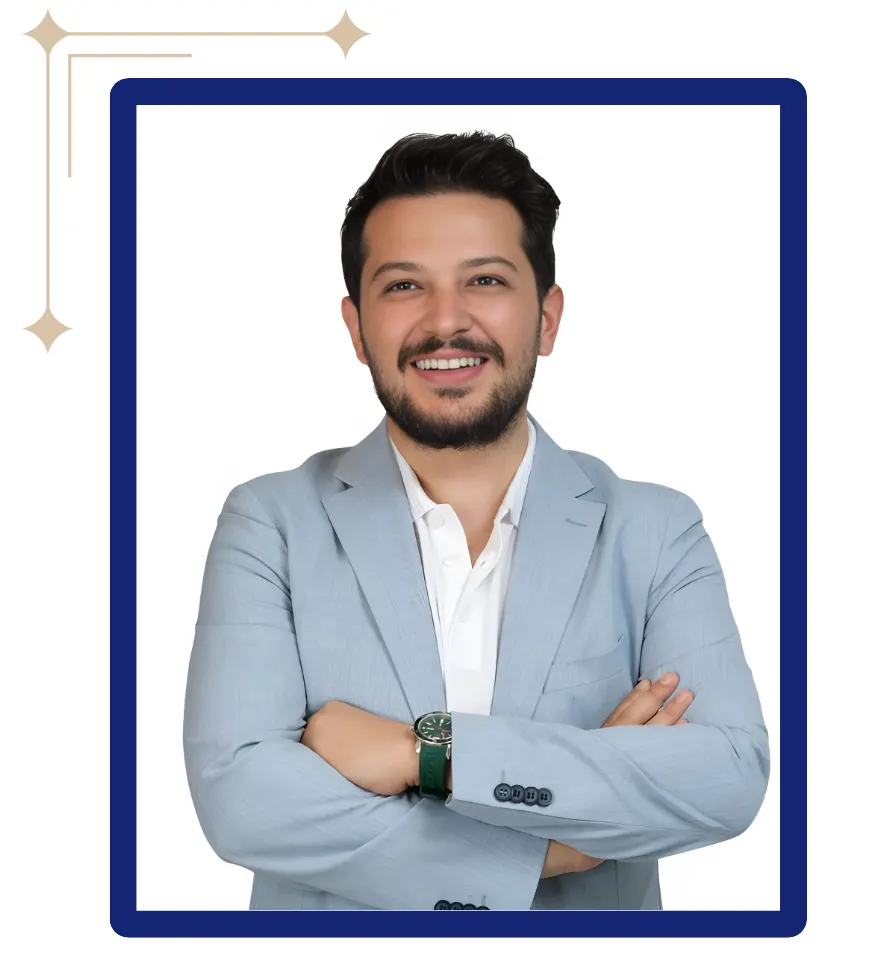
Apply these checks to us as well. The clinic’s oral and maxillofacial surgeon is Assoc. Prof. Dr. Türker Yücesoy, PhD, Associate Professor of Oral and Maxillofacial Surgery and a faculty member at Istanbul Galata University. His published profile states that he graduated from the Hacettepe University Faculty of Dentistry in 2010, completed his doctorate and specialty in oral and maxillofacial surgery in 2016, received the associate professor title in 2023, and lists the Turkish Dental Association (TDB) and the Turkish Association of Oral and Maxillofacial Surgery (TAOMS) among his professional affiliations.
His profile also lists 23+ peer-reviewed publications, cited by researchers affiliated with Harvard Medical School, Trinity College Dublin and the University of Cape Town. That is a statement about citations, not a collaboration, and not a measure of surgical results.
His areas of work at the clinic include implant surgery with complex bone loss, custom subperiosteal implants, orthognathic and jaw-contour surgery, impacted teeth, cysts and tumors, and TMJ disorders. Consultations are available in Turkish, English and French. Dr. Türker Clinic plans from a clinical examination and CBCT imaging, and offers sedation and general anesthesia for complex surgeries in a sterile environment. Orthodontic planning for patients who need surgical correction of the jaws is handled by Assoc. Prof. Dr. Elif Dilara Arslan, in coordination with Dr. Yücesoy.
Verify rather than trust: ask for his name, title, training and the facility in writing, and check them as you would for any surgeon.
Limits, alternatives and when to postpone
Limits. Credentials, profiles and checklists cannot predict your result. Jaw surgery carries risks: pain, swelling, bleeding, infection, nerve injury that may change sensation in the lip or chin, and the risks of anesthesia. The surgeon goes through the risks that apply to your case. No result can be promised, and a well-organized trip does not remove biological risk. An opinion based on an X-ray is only a first orientation; the plan can change after the examination, and may even lead to not operating.
Alternatives. Treatment close to home with a local oral and maxillofacial surgeon is a reasonable option, as is a second opinion when two plans differ. For a moderate bite discrepancy, orthodontic treatment alone may be discussed. For the chin and facial profile, non-surgical solutions exist. An impacted tooth is not always removed.
When to postpone. Hold off if you cannot get the operating surgeon’s name and qualification in writing, if there is no written plan or itemized quote, if you are pressed to pay a deposit or decide quickly, if the anesthesia arrangements are vague, or if your flight home is booked so soon after surgery that there is no room for a check-up or for complications. Recent infection or an unstable medical condition also justifies delay. Mention smoking, diabetes, blood thinners and any other treatment, and never change a medicine without the advice of the doctor who prescribed it.
When not to wait. Difficulty breathing or swallowing, swelling that spreads quickly or bleeding you cannot control call for local emergency services, not a message to a clinic abroad.
Next step
If you are considering jaw or implant surgery in Istanbul, you can send your panoramic X-ray, your CBCT scan if you have one, any reports, your medications and your goal (functional, aesthetic or both) to Dr. Türker Clinic on WhatsApp at +90 531 818 02 87 or through the contact page (see it for current opening hours). The surgeon can say whether the documents are usable and which examinations are missing. The opinion stays conditional on a clinical examination and 3D imaging.
There is no hurry at this stage. Compare written proposals and apply the checks above to every one of them, ours included.
Sources
- World Health Organization, oral health fact sheet.
- World Health Organization, Safe Surgery program.
- European Commission, Radiation Protection No 172, “Cone beam CT for dental and maxillofacial radiology”.
- American Association of Oral and Maxillofacial Surgeons (AAOMS), information for patients.
This page is an information guide: it does not make a diagnosis remotely and does not replace a clinical examination.
Frequently asked questions
Can a ranking tell me which orthognathic surgeon in Istanbul to choose?
A ranking cannot tell you which surgeon suits your case. Online lists can reflect visibility and review volume rather than clinical fit. Compare surgeons on checkable points instead: specialty title, experience with your procedure, 3D planning, a written plan and follow-up, and ask each one the same questions in writing.
What is the difference between an oral and maxillofacial surgeon and a general dentist?
A general dentist handles routine care such as fillings, root canals, crowns and simple extractions. Oral and maxillofacial surgery sits between traditional dentistry and medical surgery and treats the jaws and facial structure, not only the teeth. Titles and training routes differ by country, so ask for the exact specialty title.
How can I check a surgeon's credentials in Turkey?
Ask for the full name, exact specialty title, university and year of training, professional registration, and the name and operating authorization of the facility where surgery takes place. Then confirm them with the relevant institution, and search the surgeon's name in biomedical literature databases to see published work.
Should the surgeon who consults me also be the one who operates?
Ideally yes, or at least you should know in advance, in writing, who will operate and why. A coordinator can organize translation, transfers and hotel, but cannot replace the surgeon who explains the indication, the alternatives and the risks, and who takes your consent.
Which cases does the oral and maxillofacial surgeon at Dr. Türker Clinic treat?
At Dr. Türker Clinic, Assoc. Prof. Dr. Türker Yücesoy handles implant surgery with complex bone loss, including custom subperiosteal implants, plus orthognathic and jaw-contour surgery, impacted teeth, cysts and tumors, and temporomandibular joint (TMJ) disorders. The plan is set after a clinical examination and 3D imaging.
Is a surgeon with a university position automatically the right choice?
Not automatically. An academic position and publications show training and research activity, not that a surgeon is the right choice for your procedure. Ask how often the surgeon performs your exact operation, how complications are handled and which alternatives were considered.
Can I get a surgeon's opinion before traveling to Istanbul?
Yes. At Dr. Türker Clinic you can send a panoramic X-ray, a CBCT scan if you have one, your reports, medications and goals. The surgeon can say whether the documents are usable and what is missing. The opinion stays conditional: the plan is confirmed only after a clinical examination and 3D imaging.
This guide informs; it does not replace a consultation or an individual diagnosis. Every case needs a clinical examination and 3D imaging.


